In California, a recent law was passed called Self Determination which will change the way those who are eligible for regional center can receive services. Under this law, individuals with developmental disabilities will now have more of a voice in how they want to receive support as well as promoting integration and inclusion. Under the current system, services are often given and delivered based on a system of vendorization. With the vendor system, your regional center has to have a contract with existing agencies and providers in order to get state funding for services. Unfortunately under this system of vendors and contracts, there is great inequality and disparity in terms of the number and quality of services available depending on where clients and their families live. This has great implications and consequences because it affects the quality of life in which some individuals will get support which will enable them to live a great quality of life while others probably won't have that same opportunity based on which regional center they are a part of. For these reasons, the self determination law is crucial because it allows clients to bypass the vendor system and to exercise greater control over important aspects of services and supports.
Now I am going to talk about my own experience as to why I am happy about self determination as both someone who lives with a developmental disability as well as someone who is a client of the regional center. For starters, I became eligible for regional center services when I first got diagnosed in preschool. With the exception of paying for me to attend various summer camps and my early intervention program at UCLA as a child, my family did not rely on regional center for services such as therapy because the quality of these services were not as great. Instead, we paid out of pocket for such services. Sadly as one enters adult services, the lack of quality providers and services becomes even more evident in one's life as special education services end. This is a true depiction of my experience when I entered adult services seven years ago. I remembered when my mom and I toured various day programs, I was shocked about how these programs were run and that everything was group based and segregated rather than individualized to meet the client's needs. Often times, there were consumers with various diagnoses and abilities often clustered in a room together doing the same program. It was very depressing. Another encounter I had with adult services in which I utilized regional center was with a supported living agency. A few years ago, I was preparing to move into a dorm and I wanted someone to help me with developing independent living skills. I met and interviewed with the coordinator/supervisor of one agency that my case worker referred me to and she seemed really nice and was interested in what I wanted to say. Since she seemed to provide a good impression I decided to go with her agency. A few weeks later, I got a call from another woman who wanted to meet with me in terms of what type of support I needed help with. I was under the impression that she was going to help me find support people within the agency that would be a good fit with my personality. As it turns out, I found out that she would be the person who was going to work with me. I was a little shocked that the agency did not even think to check with me of what I was looking for in a support person before assigning this woman to me. That should be the number one thing that most providers should do before assigning support people to work with consumers since people with disabilities and their families are particular of who works with them. This is one way that people with disabilities are deny a sense of agency within the system. There were some good qualities the woman assigned to work with me possessed. For instance, she was good at helping me in the kitchen in terms of cooking. However, I could tell that she didn't have the right personality to work with me. She was passive and I could tell she was not into her job. Not only that, she lacked common sense and good judgment. One time, she picked me up from school and I noticed that her car had broken seatbelts. Since she had a trainee with her who happened to sit in the front seat, I was forced to sit in the back seat which had the defective seat belts. This was a huge liability issue and it almost put me in danger. When I brought it up to her, she didn't get how big of a deal it was that she was driving clients around with broken seat belts in her vehicle. Did the agency think to inspect her car before she was allowed to drive clients to make sure it was safe? My experience with this provider is demonstrative of the lack of oversight that often occurs in regional center services. They often hire inexperienced workers , lack training and offer low pay with a lot of staff turnover. As I got involved in the autism self advocacy movement and became a active board member for my local autism society, I noticed a lot of families had issues with regional center services from not getting services at all to getting subpar services. In addition, regional centers are often inflexible of customizing services since they require a agency to be vendored which prevents out of the box thinking when trying to help clients and their families.
This is why I am for self determination. As stated before this new law allows me to have more control in how I want to receive the support. For instance, I can choose who I want to hire to support me rather than having to use individuals that are arbitrarily assigned to me by a agency/provider. I also liked that the law allows for more room in what types of services to be funded. Most of all though, self determination presumes competence in people with disabilities and is based on the premise of inclusion. People with disabilities often feel the need to be in control of their lives. The power of choice and control, leads to greater life satisfaction. I can say from personal experience that whenever I had choice and control over something important in my life, I felt more happier and more satisfied versus when things are chosen for me based on another person's wishes. I know there are opponents against self determination with those concerned that it will enable consumers to make bad choices. But like anything else, there is a system of "checks and balances (i.e. supported decision making, independent facilitators). In the long term, having self determination within regional centers will lead to happier outcomes for people of varying abilities. It restores the true function of regional centers: by effectively serving consumers and their families.
Tuesday, March 28, 2017

Tuesday, February 28, 2017
My experience with behavioral therapy
I mentioned in passing on previous posts that I received behavioral therapy and that my therapist was the one who encouraged me to write a book. Since this is a widely discussed topic in autism circles, I wanted to write in more detail about my experiences with behavioral therapy. It is with this post that I want to discuss what I liked and dislike about receiving therapy as well as what I have learned throughout this process.
I went to various therapies in the likes of social skills classes, occupational therapy and speech therapy since getting diagnosed in preschool. I don't remember much about these therapies to have an opinion since I was really little. I did not receive the 40-hour a week ABA therapy that is prescribed to most people on the autism spectrum since it was too costly and my parents did not want to have therapists constantly around our house for so many hours a day. It wasn't until end of middle school that I started getting true behavioral therapy. Luckily, I did not receive the traditional Lovass style ABA that many autistic self advocates complain as trying to make them indistinguishable from peers, although the behavioral agency that worked with me in eighth grade had a IEP goal that treated my need for proprioceptive input by jumping up and down as a behavior that needed to be extinguish. After the agency, I started seeing a privately paid behavior therapist that was recommended by my mom's friend who also had a daughter on the autism spectrum. As stated previously, the reason why my therapist was brought on because I had great difficulty regulating my emotions as well as having great difficulties socially. My parents were concerned that I was entering high school I did not have the tools to effectively manage the transition and deal with the demands. At first, I was resistant to working with another therapist since I had a bad experience with the agency that previously worked with me. However, when I first met her, I was incredibly shocked about how personable she was. During our first session, she promised that she wouldn't push to do things I wasn't comfortable with. This made me more receptive to receiving therapy.
I am now going to talk about how I benefitted from behavioral therapy. For one thing,I learned to regulate my emotions better to the point that I no longer throw meltdowns on a daily basis. I am also happy I no longer have to rely on medication to effectively manage my anxiety. Part of how I learned to manage my emotions was through the zones of regulation curriculum. The zones referred to colors that represent the various moods and emotions a person experiences ( e.g. green means calm, yellow means stressed out/anxious and and red means upset/angry). During our sessions, my therapist and I would write out the various antecedents and try to match them to the appropriate zone. Once I identified the specific triggers that made me go into each zone or mood, I was able to gain a deeper understanding of my emotions which led us to develop a series of coping strategies to learn how to manage when I am in the red and yellow zones. Another benefit I gained from behavioral therapy was that I was encouraged to develop self advocacy and self determination skills. To achieve this, she let me set the agenda for our sessions of what I wanted to talk about and work on. As stated previously, she encouraged me to write my thoughts down in my journal which allowed me to write a book. She also made me more self reflective by making me go deep by "unpeeling the various layers" of what is bugging me. This allowed me to have a lot of Aha moments during therapy and allowed us to problem solve. I also learned to put things into perspective in therapy by drawing a line down the piece of paper of what I have control versus what I didn't have control of. The bottom line is that if I didn't receive behavioral therapy when I was younger, I wouldn't have achieved so much like graduating college and getting my first job.
Now I am going to discuss some of the things I don't like about behavior therapy and how I feel it should be improved. My biggest criticism that I can think of is that behavioral therapy is very one dimensional or that it is so focused on skill building that it doesn't take into consideration other things like mental health. I started realizing this as I got older as I got more in touch with my core values. An example I can think of was when I was sent to a two week camp against my wishes that my therapist was running during the summer before my senior year of high school. This "camp" was not your typical camp in which it was full of arts and crafts and fun activities. There were only four campers in this camp and we all stayed in a small house. During those two weeks, I felt that my therapist wanted to use that camp to emphasize teaching skills and to see how well I can do independent living skills. This was measured through various activities such as doing an exercise in learning teenage trends by sorting out what was "cool" or "uncool." Another part of the camp that I did not like, was that all of us had to do chores like clean the bathrooms or kitchen. I felt frustrated and I felt that I was put under a microscope. I let my feelings out by rebelling at the camp. Another issue or criticism I have with behavioral or any therapy for that matter was the disconnect that sometimes occurs between therapist and client. I know that there are strict confidentiality laws which prohibit a therapist to get deeply involved in the clients' lives but in the autism world just spending an hour with a therapist sitting and talking is not enough. My therapist only saw a small fraction of my life but was not there for day to day stuff like my parents and aides were. She had other clients and other responsibilities. The fact that there were 23 hours and 6 days that she didn't actually see me led us to have some disagreements about how to approach certain things and I sometimes felt she wasn't seeing where I was coming from on certain things. A final issue that I had with behavioral therapy was not so much the therapy itself but sometimes with my therapist's personality. As much as my therapist was my greatest ally and I felt that I can confide on her for most things, there were times I felt that she was a little too confrontational during our sessions. Towards the end of last year, I felt her getting increasingly inpatient during our sessions as she started adding more things on her plate (such as opening her own business). For instance, she was so concerned about me taking on my recent job as a behavioral aide that she started questioning every aspect during our sessions. It got to a point that our sessions would make me end up in tears and it wasn't helpful anymore. After 10 years of working together,I made the hard decision to stop therapy because I felt it wasn't helpful to me anymore. I wanted to have a new start without having to turn to a therapist about how to live my life.
My 10 year journey with behavioral therapy shows that therapy can be beneficial to optimizing outcomes but there comes a point that it may not be helpful anymore. I know that there is a lot of controversy regarding behavioral therapy with some self advocates having strong opinions about it. The truth is that with the right therapist and right approach it works. I learned so much about myself and gained a deeper understanding about my thought process thanks to my behavioral therapist. She taught me skills that most neurotypical people my age haven't mastered yet. Her personable approach is something I admire about her which helped me warm up to the idea of therapy. At the same time, things can change in regards to the rapport between therapist and client. Don't be afraid to stop therapy if you find that you are having issues with your therapist. As stated previously, my therapist and I worked really well for 10 years before it got to a point where it wasn't working out. It maybe time for a new approach or find other avenues in which to receive support. My experience has also given me the insight that behavioral therapy might be beneficial at a certain developmental stage but can be less effective or can have detrimenttal effects as one gets older or moves on to another stage of life. This shows that autism doesn't go away but it needs to be treated differently throughout the various stages of life.

I went to various therapies in the likes of social skills classes, occupational therapy and speech therapy since getting diagnosed in preschool. I don't remember much about these therapies to have an opinion since I was really little. I did not receive the 40-hour a week ABA therapy that is prescribed to most people on the autism spectrum since it was too costly and my parents did not want to have therapists constantly around our house for so many hours a day. It wasn't until end of middle school that I started getting true behavioral therapy. Luckily, I did not receive the traditional Lovass style ABA that many autistic self advocates complain as trying to make them indistinguishable from peers, although the behavioral agency that worked with me in eighth grade had a IEP goal that treated my need for proprioceptive input by jumping up and down as a behavior that needed to be extinguish. After the agency, I started seeing a privately paid behavior therapist that was recommended by my mom's friend who also had a daughter on the autism spectrum. As stated previously, the reason why my therapist was brought on because I had great difficulty regulating my emotions as well as having great difficulties socially. My parents were concerned that I was entering high school I did not have the tools to effectively manage the transition and deal with the demands. At first, I was resistant to working with another therapist since I had a bad experience with the agency that previously worked with me. However, when I first met her, I was incredibly shocked about how personable she was. During our first session, she promised that she wouldn't push to do things I wasn't comfortable with. This made me more receptive to receiving therapy.
I am now going to talk about how I benefitted from behavioral therapy. For one thing,I learned to regulate my emotions better to the point that I no longer throw meltdowns on a daily basis. I am also happy I no longer have to rely on medication to effectively manage my anxiety. Part of how I learned to manage my emotions was through the zones of regulation curriculum. The zones referred to colors that represent the various moods and emotions a person experiences ( e.g. green means calm, yellow means stressed out/anxious and and red means upset/angry). During our sessions, my therapist and I would write out the various antecedents and try to match them to the appropriate zone. Once I identified the specific triggers that made me go into each zone or mood, I was able to gain a deeper understanding of my emotions which led us to develop a series of coping strategies to learn how to manage when I am in the red and yellow zones. Another benefit I gained from behavioral therapy was that I was encouraged to develop self advocacy and self determination skills. To achieve this, she let me set the agenda for our sessions of what I wanted to talk about and work on. As stated previously, she encouraged me to write my thoughts down in my journal which allowed me to write a book. She also made me more self reflective by making me go deep by "unpeeling the various layers" of what is bugging me. This allowed me to have a lot of Aha moments during therapy and allowed us to problem solve. I also learned to put things into perspective in therapy by drawing a line down the piece of paper of what I have control versus what I didn't have control of. The bottom line is that if I didn't receive behavioral therapy when I was younger, I wouldn't have achieved so much like graduating college and getting my first job.
Now I am going to discuss some of the things I don't like about behavior therapy and how I feel it should be improved. My biggest criticism that I can think of is that behavioral therapy is very one dimensional or that it is so focused on skill building that it doesn't take into consideration other things like mental health. I started realizing this as I got older as I got more in touch with my core values. An example I can think of was when I was sent to a two week camp against my wishes that my therapist was running during the summer before my senior year of high school. This "camp" was not your typical camp in which it was full of arts and crafts and fun activities. There were only four campers in this camp and we all stayed in a small house. During those two weeks, I felt that my therapist wanted to use that camp to emphasize teaching skills and to see how well I can do independent living skills. This was measured through various activities such as doing an exercise in learning teenage trends by sorting out what was "cool" or "uncool." Another part of the camp that I did not like, was that all of us had to do chores like clean the bathrooms or kitchen. I felt frustrated and I felt that I was put under a microscope. I let my feelings out by rebelling at the camp. Another issue or criticism I have with behavioral or any therapy for that matter was the disconnect that sometimes occurs between therapist and client. I know that there are strict confidentiality laws which prohibit a therapist to get deeply involved in the clients' lives but in the autism world just spending an hour with a therapist sitting and talking is not enough. My therapist only saw a small fraction of my life but was not there for day to day stuff like my parents and aides were. She had other clients and other responsibilities. The fact that there were 23 hours and 6 days that she didn't actually see me led us to have some disagreements about how to approach certain things and I sometimes felt she wasn't seeing where I was coming from on certain things. A final issue that I had with behavioral therapy was not so much the therapy itself but sometimes with my therapist's personality. As much as my therapist was my greatest ally and I felt that I can confide on her for most things, there were times I felt that she was a little too confrontational during our sessions. Towards the end of last year, I felt her getting increasingly inpatient during our sessions as she started adding more things on her plate (such as opening her own business). For instance, she was so concerned about me taking on my recent job as a behavioral aide that she started questioning every aspect during our sessions. It got to a point that our sessions would make me end up in tears and it wasn't helpful anymore. After 10 years of working together,I made the hard decision to stop therapy because I felt it wasn't helpful to me anymore. I wanted to have a new start without having to turn to a therapist about how to live my life.
My 10 year journey with behavioral therapy shows that therapy can be beneficial to optimizing outcomes but there comes a point that it may not be helpful anymore. I know that there is a lot of controversy regarding behavioral therapy with some self advocates having strong opinions about it. The truth is that with the right therapist and right approach it works. I learned so much about myself and gained a deeper understanding about my thought process thanks to my behavioral therapist. She taught me skills that most neurotypical people my age haven't mastered yet. Her personable approach is something I admire about her which helped me warm up to the idea of therapy. At the same time, things can change in regards to the rapport between therapist and client. Don't be afraid to stop therapy if you find that you are having issues with your therapist. As stated previously, my therapist and I worked really well for 10 years before it got to a point where it wasn't working out. It maybe time for a new approach or find other avenues in which to receive support. My experience has also given me the insight that behavioral therapy might be beneficial at a certain developmental stage but can be less effective or can have detrimenttal effects as one gets older or moves on to another stage of life. This shows that autism doesn't go away but it needs to be treated differently throughout the various stages of life.

Sunday, February 5, 2017
There is no one way of being autistic
"If you met ONE person with autism you met ONE person with autism." This is a phrase that is frequently tossed around in the autistic community. As a autistic self advocate, I could not have agree more with this saying. So why does it seem people often forget this important wisdom when writing and discussing about autism. I cannot tell you enough about how many articlesand books that I have come across that takes a cookie cutter "one-size-fits-all" approach regarding autism. This comes across as author giving "advice" and uses commanding language like the word "should". Even self advocates themselves sometimes phrase stuff in their writing that comes across that others on the spectrum experience the world the same way I understand that autism is a very complex condition to understand. People often crave something concrete and if you are a parent who needs help and guidance on how to raise a child with autism, a professional who wants to better help their clients or a self advocate who want to better understand their condition, I get why these instruction-manual and a more standardized-universal approach can be helpful. The problem lies when people take certain perspectives or approaches on autism and thinks it should be applicable to all autistic people. When you take the experience of one autistic person and apply it broadly, you are ignoring the vast diversity that exists in autistic community. An example of the universalization approach to autism I can think of is Temple Grandin. Don't get me wrong, Temple Grandin is an exceptional woman as she beat the odds and got a Ph.D in animal science and is a widely acclaimed speaker and author. She is also the first one to speak out for autism acceptance and point out the extraordinary gifts and talents of autistic people. However, I feel that people treat her as a "autism messiah" and that her perspective and experiences of being autistic applies to everyone on the spectrum. This is unfair and problematic because it creates a false illusion that ALL autistics are like and should be like Temple Grandin. Temple doesn't have the personal experience of what life is like of being a nonverbal autistic (especially those who type to communicate), the experience being part of a ethnic minority group or being a LGBT etc. The list could go on and on but the point being is that different perspectives are overlooked or not given much attention in the autism community when we just give spotlight to the words and insights of one autistic person.
Going back to the beginning of this blog post of people craving simplicity or clear cut guidelines when dealing with autism, you might be asking of how do you treat autism or what should I do with myself. child or client. My advice to you is to accept the natural variation of experiences that exist in the autism community and to focus on what is relevant to yourself or your child and what you want or need. Autistics are like ordinary people with different experiences, upbringing, and viewpoints and are not always going to agree with each other. An excellent example illustrating the vast diversity that exists along the spectrum is through comic Rebecca Burgess's reference to autism as a colorwheel.. A color wheel is filled with many different shades of colors rather than concrete primary colors. The autism spectrum is the same way with different shades or variance in how different people experience autistic symptoms. For instance some people with autism are social and want a lot of friends while others are more shy and are happy with a few social connections. Some autistics have more issues with there sensory system while others have fewer issues in this area. To conclude this post, each autistic person has a unique story with valuable insights on what it means to be autistic. Therefore, it is extremely important for self advocates, parents and professionals in the greater autism community to be more open to hearing different experiences.
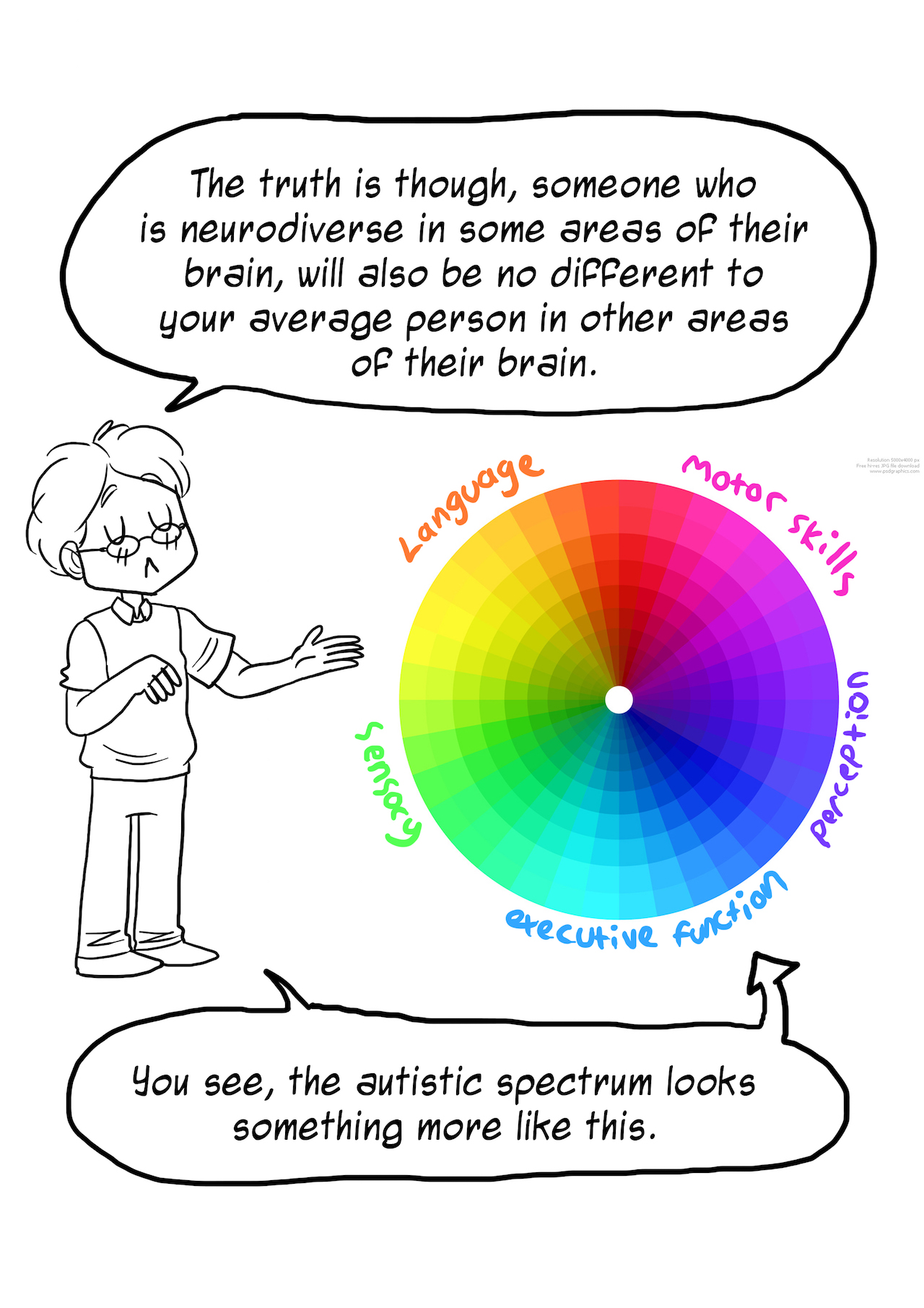
Photo credit: Rebecca Burgess (comic)
Going back to the beginning of this blog post of people craving simplicity or clear cut guidelines when dealing with autism, you might be asking of how do you treat autism or what should I do with myself. child or client. My advice to you is to accept the natural variation of experiences that exist in the autism community and to focus on what is relevant to yourself or your child and what you want or need. Autistics are like ordinary people with different experiences, upbringing, and viewpoints and are not always going to agree with each other. An excellent example illustrating the vast diversity that exists along the spectrum is through comic Rebecca Burgess's reference to autism as a colorwheel.. A color wheel is filled with many different shades of colors rather than concrete primary colors. The autism spectrum is the same way with different shades or variance in how different people experience autistic symptoms. For instance some people with autism are social and want a lot of friends while others are more shy and are happy with a few social connections. Some autistics have more issues with there sensory system while others have fewer issues in this area. To conclude this post, each autistic person has a unique story with valuable insights on what it means to be autistic. Therefore, it is extremely important for self advocates, parents and professionals in the greater autism community to be more open to hearing different experiences.
Photo credit: Rebecca Burgess (comic)
Saturday, January 21, 2017
Self acceptance and Self Care
This is kind of related to an earlier blog post on being a perfectionism on the autism spectrum that I wrote last month. It is about developing a sense of self acceptance and care for individuals on the spectrum. I consider this a goal and New Years resolution to develop more self acceptance because I feel that I will feel more happier and liberated. Believe it or not, I am constantly criticizing myself over my beliefs and choices even though I know what I want for myself. This comes in the form of constant questioning, doubting and cross examining my needs and wants. Unfortunately this has the consequence of creating unnecessary anxiety and is a form of self-injury. I feel that my brain is constantly attacking me and I am never satisfied of myself and where I am now in my life. For instance, I feel that I should be a more thoughtful person than I am now and call myself a "selfish" and self centered person because I have natural desires of wanting things for myself. Another habit related to my inability to accept myself is my constant comparison to others and the use of "should" statements. When I see friends or peers doing something I am not yet doing, I feel that I should be on the same track as they are if I am to be on track to a good life.
How I developed these self destructive habits has to do with the external situation that I currently live in (being a autistic person living in a neurotypical world) and what I was subjected to during my formative years. As stated previously, I was placed in various therapies in which I was constantly compared to peers (both neurotypicals and others with disabilities). When I was younger, my mother made these statements comparing me to my classmates as well as her friends' children who were a similar age. She would make these statements such as "someone so is doing this, how come you can't do this." The people in my life made decisions for me that I necessary would not have made for myself if I was put into the driver's seat. For instance, friends were chosen for me because my parents and therapists wanted me to be more social and to have the experience and more social opportunities available to me.. Although the intentions were good, it had the down side of creating a self destructive script that I do not make good choices in my life and my desire to be a "loner" (meaning I don't crave so many friends in order to be happy) was not socially acceptable. It also didn't help that my behavioral therapist was the type of person who would sometimes cross examine me during our sessions and it would lead me to self doubt my decisions despite being confident about them internally. It doesn't help that in the greater autism community, autistics are ranked against each other based on how they conform to neurotypical expectations. All these factors that I was exposed to growing up has led me to internally believe that no matter the compliments people gave me or the accomplishments I have achieved so far, I still cannot internally accept myself or my core beliefs.
Luckily I am still young enough to combat these self destructive scripts and can lead a more happier life for myself. My status as an adult allows me to make the choices in terms of how I want to live my life that I wasn't able to make when I was in high school. How I am going to get pass the negative scripts that I acquired during my adolescence and early college years, is to focus on accepting myself the way I am. This is accepting my strengths, accomplishments and also my limitations. It is accepting the fact that there are going to be people in this world(both neurotypicals and other people with disabilities) who are going to be more accomplished and more independent than I am but that doesn't mean that I am less deserving of the right to live a happy life compared to these people. Another component of self acceptance is self care. Autistics like myself were always taught to think more about other people and to put their desires first before their own. However, as the saying goes is that you can't help others until you take care of your needs first. Like neurotypical people, this rule applies to people with autism (perhaps more so, because we have a more limited energy capacity compared to the average person). The notion of self care can look different for each person since people have different needs and wants. To look at my life as an example, part of self care for me involved hiring a part time support person who can drive me around to various places in the community as well as providing companionship to me. Although I can function without this person, hiring a community support companion made my life easier since it frees myself from the drama and emotional baggage that a two way friendship often brings. This is one way autistics can achieve self care. However other forms of self care that worked for me as well as other adults with autism include finding other autistic people to connect with, finding a passion or special interest, watching cartoons or movies on the weekends as well as many more activities that would be too long to list here. Both self acceptance and self care remind all of us to embrace the journey and that there is on such thing as perfection. Without self acceptance and self care, we wouldn't be able to function in our day to day lives. I know for myself that it is going to take awhile to get over these self defeating scripts and to develop true self acceptance but I believe that one day I will get there. Writing this blog post is one step towards my goal of self acceptance and self care. If self acceptance and self care were more emphasized in autism interventions it would reduce some of the high rates of anxiety and depression that is so prevalent in this population. I hope my post on self acceptance and self care would be helpful to those both on and off the spectrum who are struggling with this issue right now.
How I developed these self destructive habits has to do with the external situation that I currently live in (being a autistic person living in a neurotypical world) and what I was subjected to during my formative years. As stated previously, I was placed in various therapies in which I was constantly compared to peers (both neurotypicals and others with disabilities). When I was younger, my mother made these statements comparing me to my classmates as well as her friends' children who were a similar age. She would make these statements such as "someone so is doing this, how come you can't do this." The people in my life made decisions for me that I necessary would not have made for myself if I was put into the driver's seat. For instance, friends were chosen for me because my parents and therapists wanted me to be more social and to have the experience and more social opportunities available to me.. Although the intentions were good, it had the down side of creating a self destructive script that I do not make good choices in my life and my desire to be a "loner" (meaning I don't crave so many friends in order to be happy) was not socially acceptable. It also didn't help that my behavioral therapist was the type of person who would sometimes cross examine me during our sessions and it would lead me to self doubt my decisions despite being confident about them internally. It doesn't help that in the greater autism community, autistics are ranked against each other based on how they conform to neurotypical expectations. All these factors that I was exposed to growing up has led me to internally believe that no matter the compliments people gave me or the accomplishments I have achieved so far, I still cannot internally accept myself or my core beliefs.
Luckily I am still young enough to combat these self destructive scripts and can lead a more happier life for myself. My status as an adult allows me to make the choices in terms of how I want to live my life that I wasn't able to make when I was in high school. How I am going to get pass the negative scripts that I acquired during my adolescence and early college years, is to focus on accepting myself the way I am. This is accepting my strengths, accomplishments and also my limitations. It is accepting the fact that there are going to be people in this world(both neurotypicals and other people with disabilities) who are going to be more accomplished and more independent than I am but that doesn't mean that I am less deserving of the right to live a happy life compared to these people. Another component of self acceptance is self care. Autistics like myself were always taught to think more about other people and to put their desires first before their own. However, as the saying goes is that you can't help others until you take care of your needs first. Like neurotypical people, this rule applies to people with autism (perhaps more so, because we have a more limited energy capacity compared to the average person). The notion of self care can look different for each person since people have different needs and wants. To look at my life as an example, part of self care for me involved hiring a part time support person who can drive me around to various places in the community as well as providing companionship to me. Although I can function without this person, hiring a community support companion made my life easier since it frees myself from the drama and emotional baggage that a two way friendship often brings. This is one way autistics can achieve self care. However other forms of self care that worked for me as well as other adults with autism include finding other autistic people to connect with, finding a passion or special interest, watching cartoons or movies on the weekends as well as many more activities that would be too long to list here. Both self acceptance and self care remind all of us to embrace the journey and that there is on such thing as perfection. Without self acceptance and self care, we wouldn't be able to function in our day to day lives. I know for myself that it is going to take awhile to get over these self defeating scripts and to develop true self acceptance but I believe that one day I will get there. Writing this blog post is one step towards my goal of self acceptance and self care. If self acceptance and self care were more emphasized in autism interventions it would reduce some of the high rates of anxiety and depression that is so prevalent in this population. I hope my post on self acceptance and self care would be helpful to those both on and off the spectrum who are struggling with this issue right now.
Sunday, December 4, 2016
Perfectionism and Living on the autism spectrum
I want to discuss a very personal topic as it relates to how I view myself and how living with an autism spectrum disorder manifests in my own life. Although I appear to be self confident when talking in front of people and doing speeches, the truth is that I struggle with being a perfectionist and feel that I am not good enough. This gets manifested in low self confidence, being concerned of how others perceive me , asking for reassurance all the time from family and others who work with me, internally questioning my beliefs and anxiety. Unfortunately, as I grew older and accomplish more milestones such as graduating high school, graduating college, and getting a job my perfectionistic ego has only gotten bigger. I constantly feel that I should be doing more than I am now and should not make any mistakes or short comings. This attitude crosses all domains including work, friendships, how I view my autism as well as school performance. On the plus side, being a perfectionist has made me achieve a lot and has helped me survive through college and pulling mostly A's and B's in my classes as well as helping me developing a good work ethic as an employee. However, it has the detrimental effect of creating unnecessary anxiety and lowering my self confidence and self esteem and also creating unrealistic expectations on myself.
You might be asking what being a perfectionist has to do with living on the autism spectrum since typical people also struggle with holding perfectionistic attitudes. How this ties with autism is that from an early age, we are put into behavioral therapies and social skills training classes which strive to assimilate us into acting normal. Traditional behavioral therapies such as Applied Behavioral Analysis reward children for displaying desirable behaviors and ignores them for displaying autistic behaviors such as hand flapping, scripting, jumping etc. This gets reinforced in schools through special education programs and goals written in the Individualized Education Plan which have a strict baseline dates in which such goals should be met. This is a true depiction of my life as I look back of when I was going through school and the trajectory of how I developed a perfectionistic attitude. I went to a lot of therapies as a child and went through various social skills classes as well as starting behavioral therapy when I was in eighth grade. Sometimes, I felt I was always placed under a microscope in which I felt that all of my behaviors were constantly under surveillance by my parents, therapists and support staff. My behavior was always measured with data sheets, emails, monthly team meetings, annual IEP meetings etc. A specific moment in my life in which I really felt that I was under constant surveillance is when I was sent to a two week camp (that I did not want to go) at my behavior therapist's suggestion during the summer of my senior year in which all the activities were closely monitored and all centered on learning cognitive behavioral techniques and to see how well I could perform independent living skills like cooking and cleaning. Let's just say that I was happy to go home when those two weeks were up. Although the people in my life had good intentions and I wouldn't be in the place where I am now without all the skills that I learned as a result of these intervention and experiences, it contributed to my need in pleasing people and anxiety in needing to be perfect and normal. My experience and others on the spectrum that I talked to who have anxiety related to the desire to be perfect shows that behavioral interventions and school programs should be less focused on making autistic people act and look at the world in a neurotypical way and be more holistic, relational, and to take into account the needs, thoughts and feelings of the student and client. Another aspect I would like to see in the development of new treatments and interventions for those on the spectrum is the focus more on mental health and developing autism acceptance and positive self esteem for those on the spectrum.
Now as a young adult on the spectrum, I am slowly learning to not be so perfectionistic and to get anxious over the little stuff. I am learning that I am good enough and that I should not be so focused on what others think of me and to feel more confident in the choices I make instead of doubting and questioning them. It will be a slow journey since I have held these attitudes for years but I feel that the journey of letting go of my perfectionistic scripts would allow me to develop a greater self acceptance and to enjoy each step of my life journey. After all, it is about the journey and not the destination that counts.

You might be asking what being a perfectionist has to do with living on the autism spectrum since typical people also struggle with holding perfectionistic attitudes. How this ties with autism is that from an early age, we are put into behavioral therapies and social skills training classes which strive to assimilate us into acting normal. Traditional behavioral therapies such as Applied Behavioral Analysis reward children for displaying desirable behaviors and ignores them for displaying autistic behaviors such as hand flapping, scripting, jumping etc. This gets reinforced in schools through special education programs and goals written in the Individualized Education Plan which have a strict baseline dates in which such goals should be met. This is a true depiction of my life as I look back of when I was going through school and the trajectory of how I developed a perfectionistic attitude. I went to a lot of therapies as a child and went through various social skills classes as well as starting behavioral therapy when I was in eighth grade. Sometimes, I felt I was always placed under a microscope in which I felt that all of my behaviors were constantly under surveillance by my parents, therapists and support staff. My behavior was always measured with data sheets, emails, monthly team meetings, annual IEP meetings etc. A specific moment in my life in which I really felt that I was under constant surveillance is when I was sent to a two week camp (that I did not want to go) at my behavior therapist's suggestion during the summer of my senior year in which all the activities were closely monitored and all centered on learning cognitive behavioral techniques and to see how well I could perform independent living skills like cooking and cleaning. Let's just say that I was happy to go home when those two weeks were up. Although the people in my life had good intentions and I wouldn't be in the place where I am now without all the skills that I learned as a result of these intervention and experiences, it contributed to my need in pleasing people and anxiety in needing to be perfect and normal. My experience and others on the spectrum that I talked to who have anxiety related to the desire to be perfect shows that behavioral interventions and school programs should be less focused on making autistic people act and look at the world in a neurotypical way and be more holistic, relational, and to take into account the needs, thoughts and feelings of the student and client. Another aspect I would like to see in the development of new treatments and interventions for those on the spectrum is the focus more on mental health and developing autism acceptance and positive self esteem for those on the spectrum.
Now as a young adult on the spectrum, I am slowly learning to not be so perfectionistic and to get anxious over the little stuff. I am learning that I am good enough and that I should not be so focused on what others think of me and to feel more confident in the choices I make instead of doubting and questioning them. It will be a slow journey since I have held these attitudes for years but I feel that the journey of letting go of my perfectionistic scripts would allow me to develop a greater self acceptance and to enjoy each step of my life journey. After all, it is about the journey and not the destination that counts.

Monday, October 17, 2016
Ableism and why I named my blog "Redefining Normal"
This post has been on my mind for awhile but have been getting sidetracked with life and adjusting to my new job. However, I feel this is a topic worth talking about especially in the 21st century in which there are numerous social justice movements that fight for the lives of oppressed and marginalized groups in the United States. It is about ableism. Unlike other movements such as racism, sexism,homophobia etc. this concept is less known and discussed when it comes to social justice within American society. However, it is a concept that pervades all aspects of U.S. society and has either directly or indirectly oppress and marginalized people with disabilities. Unfortunately, there is no way to talk about this concept in a way that does not sound angry. So try to bear with me if I sometimes sound angry when writing this post. Since this blog is about autism and to avoid this post from getting too disorganized, I am going to focus solely as to how ableism affects the autistic community as a whole.
I am not the only autistic self advocate that writes about ableism. Autistic advocates such as Lydia Brown and nonverbal autistic, Amy Sequenzia talks about how ableism affects the autism community and their experiences of being autistic. Ableism is a powerful concept because it has the consequence of some autistics not having access to education and employment, having access to supports and accommodations as well as being a barrier of living a happy life. Growing up, I have been exposed to ableist concepts that in turn negatively affected my self esteem. This was either overtly or subtly and sometimes within the autism community. Ableist concepts that I was subject to was the notion of age appropriate interests, pushing for complete independence/ self sufficiency and the notion that there is only one way of social connections with people and friendships which is the notion of peer groups. I have internalized these messages by reading so many autism books written by neurotypical parents and professionals as well as observing the direct and indirect messages from family, some friends and support people. For instance, I was encouraged to join clubs which included a lot of group interaction, to dress like the other girls in school and to socialize with more same age peers than adults. Although the people in my life at the time had good intentions, it had the unfortunate consequence of creating and sustaining an ableist script in my head which in turn lead to my low self confidence in young adulthood in which I am learning to let go.
Ableism also leads to false assumptions about the intentions and desires of people with disabilities. For instance, in this media story a football player sits with a boy with autism who often wants to sit alone. While on the surface it comes across as a heartwarming story to viewers it comes across as ableist by making the assumption that all autistics or people with disabilities should and want to sit with people and socialize during lunch. Some people prefer to sit alone at lunch since it is their only time they can relax and take a break from being around other people. I, myself am a introverted person. During breaks such as lunch, I prefer to have alone time since it allows me to decompress especially if I am around people for most of the day. Media stories such as the football player sitting with the autistic boy at lunch is an example of "feel good" stories in which a neurotypical person is portrayed as "helping" a disabled person achieve "normal" or typical experiences is known as inspiration porn. Inspiration porn-like stories have no direct benefit for people who have autism or other disabilities but instead portrays us as needy and that we should be treated with pity.
Challenging ableist views of society and that there is only "one" correct way to live and experience life is the reason why I named my blog "Redefining Normal." I wanted to use this blog as an opportunity to educate others on how I see the world and to educate others that there is more than one way to live a successful and happy life. . However, the writings of self advocates like myself are under utilized as the works of well-known neurotypical experts and parent's accounts of autism are more valued by the greater society which promotes more ableist views on autism. The good news is that we are at a time in which more autistics are speaking out and sharing their stories and that more people are willing to listen. I think it is time that we have a dialogue about how ableism is pervasive in our society and how it is a social justice issue just like race, gender and sexual orientation. If people are more aware and mindful of ableist attitudes, we have the opportunity to combat it and make society a more accepting and loving place for those who live with disabilities.

I am not the only autistic self advocate that writes about ableism. Autistic advocates such as Lydia Brown and nonverbal autistic, Amy Sequenzia talks about how ableism affects the autism community and their experiences of being autistic. Ableism is a powerful concept because it has the consequence of some autistics not having access to education and employment, having access to supports and accommodations as well as being a barrier of living a happy life. Growing up, I have been exposed to ableist concepts that in turn negatively affected my self esteem. This was either overtly or subtly and sometimes within the autism community. Ableist concepts that I was subject to was the notion of age appropriate interests, pushing for complete independence/ self sufficiency and the notion that there is only one way of social connections with people and friendships which is the notion of peer groups. I have internalized these messages by reading so many autism books written by neurotypical parents and professionals as well as observing the direct and indirect messages from family, some friends and support people. For instance, I was encouraged to join clubs which included a lot of group interaction, to dress like the other girls in school and to socialize with more same age peers than adults. Although the people in my life at the time had good intentions, it had the unfortunate consequence of creating and sustaining an ableist script in my head which in turn lead to my low self confidence in young adulthood in which I am learning to let go.
Ableism also leads to false assumptions about the intentions and desires of people with disabilities. For instance, in this media story a football player sits with a boy with autism who often wants to sit alone. While on the surface it comes across as a heartwarming story to viewers it comes across as ableist by making the assumption that all autistics or people with disabilities should and want to sit with people and socialize during lunch. Some people prefer to sit alone at lunch since it is their only time they can relax and take a break from being around other people. I, myself am a introverted person. During breaks such as lunch, I prefer to have alone time since it allows me to decompress especially if I am around people for most of the day. Media stories such as the football player sitting with the autistic boy at lunch is an example of "feel good" stories in which a neurotypical person is portrayed as "helping" a disabled person achieve "normal" or typical experiences is known as inspiration porn. Inspiration porn-like stories have no direct benefit for people who have autism or other disabilities but instead portrays us as needy and that we should be treated with pity.
Challenging ableist views of society and that there is only "one" correct way to live and experience life is the reason why I named my blog "Redefining Normal." I wanted to use this blog as an opportunity to educate others on how I see the world and to educate others that there is more than one way to live a successful and happy life. . However, the writings of self advocates like myself are under utilized as the works of well-known neurotypical experts and parent's accounts of autism are more valued by the greater society which promotes more ableist views on autism. The good news is that we are at a time in which more autistics are speaking out and sharing their stories and that more people are willing to listen. I think it is time that we have a dialogue about how ableism is pervasive in our society and how it is a social justice issue just like race, gender and sexual orientation. If people are more aware and mindful of ableist attitudes, we have the opportunity to combat it and make society a more accepting and loving place for those who live with disabilities.

Monday, September 5, 2016
My embarkation into the employment world
I recently been offered a job as a 1:1 aide for a special autism school. I've never thought it would happen so soon as I just began actively looking for a job. To assist me in the daunting process of finding a job, I utilized a supported employment agency that has an employment specialist actively search for jobs on my behalf as well as providing me with a job coach once I get hired. To began the story, the school asked me to come in for a interview. Originally the job advertised on the job search engine Indeed was for a special education teacher, but since I don't have a teaching credential, the employment specialist sent an email asking if there were any other job openings that fit my qualifications. It turned out that there was an opening for a 1:1 aide position in a autism classroom. I interviewed for the job and they basically asked questions about my volunteer experience as advertised on my resume as well as giving me scenarios of how I would resolve situations since the job entails thinking on your feet which involves problem solving, emotional regulation and having good judgment. When the guy interviewing me asked these questions, I began to feel nervous since I felt I was totally unprepared for this part. However, I guess I managed to do very well because an hour after the interview was over, the director of the school called me and offered me a job and asked me to get my fingerprints and a TB test so they can hire me. When I received the phone call, I felt incredibly overwhelmed with excitement and nervousness. I was excited because I was thrilled that someone wanted to hire me despite having a disability. Until then, I was starting to feel down about my employability because of my disability especially in this competitive job market.
On the other hand, I feel nervous because like any other transition, I am venturing into unknown territory in being a 1:1 aide especially since there is a huge emotional investment in this line of work. I have been trying to process my own emotions in taking on a caregiving role as an aide. I have been on the other side as I had aide help throughout school as well as currently employing a support person for social recreational purposes. However, the thing that has been eating me is that since I am capable of supporting another student, I feel that people would put me on a pedestal and feel that I can't have support in my own life. I know this is my perfectionistic self speaking, but since I am already an exemplary in the autism community for all I have accomplished, I am holding myself up to high expectations. There is a lot of emotions surrounding me taking on this position as I have to process taking on such a huge role and the duality in simultaneously being a support person as well as being the receiver of support.
It is going to be an adjustment period as I embark on this journey and there will be days that will be tough on me emotionally. Overall, I look at this job as a stepping stone in what I ultimately want to do in life. This is a way of cessing if this is the right field for me. I am glad that someone is willing to give me a chance at employment especially since the hiring rate for people with disabilities is so low in this job climate.
On the other hand, I feel nervous because like any other transition, I am venturing into unknown territory in being a 1:1 aide especially since there is a huge emotional investment in this line of work. I have been trying to process my own emotions in taking on a caregiving role as an aide. I have been on the other side as I had aide help throughout school as well as currently employing a support person for social recreational purposes. However, the thing that has been eating me is that since I am capable of supporting another student, I feel that people would put me on a pedestal and feel that I can't have support in my own life. I know this is my perfectionistic self speaking, but since I am already an exemplary in the autism community for all I have accomplished, I am holding myself up to high expectations. There is a lot of emotions surrounding me taking on this position as I have to process taking on such a huge role and the duality in simultaneously being a support person as well as being the receiver of support.
It is going to be an adjustment period as I embark on this journey and there will be days that will be tough on me emotionally. Overall, I look at this job as a stepping stone in what I ultimately want to do in life. This is a way of cessing if this is the right field for me. I am glad that someone is willing to give me a chance at employment especially since the hiring rate for people with disabilities is so low in this job climate.
Subscribe to:
Posts (Atom)